High-Risk Removals · Gainesville, FL
Hazardous Tree Removal in Gainesville, FL
A tree becomes a hazard when a weakness meets something worth protecting. We take down leaning, cracked and decayed trees over houses, pools and driveways with rigging chosen so the weak wood never carries a load it cannot handle.
- Typical range
- $800 – $3,500+
- Common defects
- Leans, splits, rot, root failure
- Permit relief
- FS 163.045 when documented
- Priority
- Scheduled ahead of routine work
Hazardous Tree Removal Gainesville FL Homeowners Ask About
Arborists who assess trees for a living do not call a tree dangerous just because it looks rough. They weigh three things: how likely the tree or a part of it is to fail, how likely it is to hit something when it does, and how bad that hit would be. A rotten tree in the middle of a pasture is low risk. A sound-looking oak with a cracked fork hanging over a child's bedroom is not.
That way of thinking is useful for homeowners too, and it shapes how we price and schedule these jobs. This page covers the defects that put a tree in the hazardous category, how Florida law treats a documented risk, and how a crew takes apart a tree that cannot be trusted. For routine takedowns, see how a standard takedown works.
Gainesville Hazardous Trees: The Defects That Matter
- A lean that changed. Many trees grow at an angle and stay put for decades. A lean that appeared after a storm, often with cracked soil or a raised root plate on the far side, means the roots have let go.
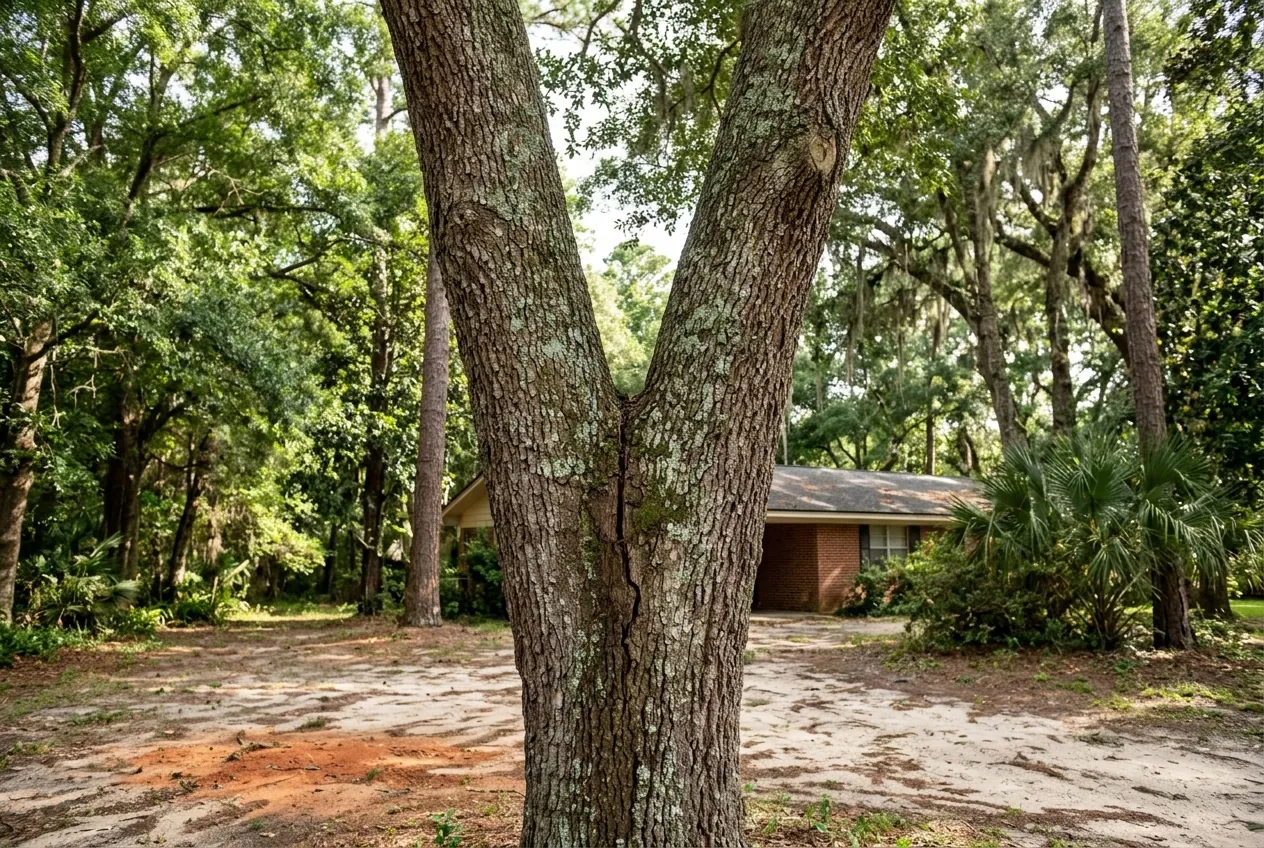
- Cracks and splits. Vertical cracks in the trunk, or a fork pulling apart at the joint, show wood that has already partly failed.
- Included bark. Two trunks of similar size joined in a tight V, with bark pinched between them, form a weak union. Water oaks and laurel oaks grow this way often.
- Decay at the base. Mushrooms, conks, soft wood or a hollow sound when tapped near the root flare mean the part of the tree holding everything up is compromised.
- Root damage. Trenching for irrigation, septic work, a new driveway or a pool can sever major roots on one side. Trees often look fine for a year or two before declining or tipping.
- Hangers. Broken limbs caught in the canopy can drop at any time, with no warning and no sound.
Not every defect means removal. A single bad limb can sometimes be cut out and the tree kept. But when the trunk, the main fork or the roots are involved, removal is usually the only practical fix. The post on signs a tree needs to be removed has photos of what these defects look like.
Florida Statute 163.045 and Hazardous Tree Removal in Gainesville
State law gives owners of single-family detached homes a way around local permits for genuinely dangerous trees. Under Florida Statute 163.045, an owner holding the right paperwork showing a tree is an unacceptable risk owes the local government no permit, no application, no fee, no mitigation and no replacement planting for removing it.
The details matter. The documentation must be an onsite assessment that follows the tree risk assessment procedures in the ISA's best management practices, second edition, and only two kinds of professionals can sign it: an ISA-credentialed arborist, or a landscape architect holding a Florida license. The statute defines an unacceptable risk as one where nothing short of removal can practically lower the risk under the moderate level. A tree that could be made safe with pruning or cabling does not qualify.
Hazardous Tree Removal Over Houses and Drives
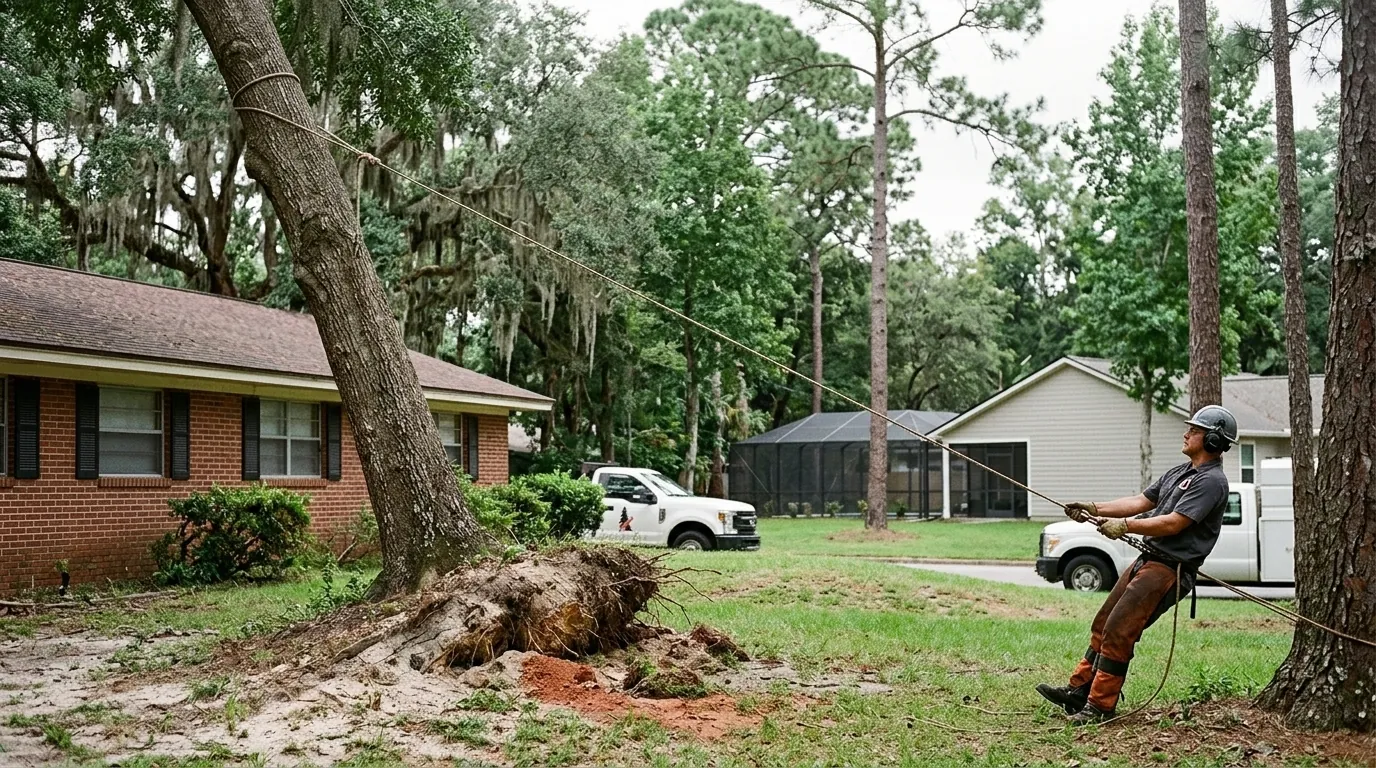
The core rule on a hazard job is simple: the weak part of the tree never takes a load it cannot carry. That changes the rigging plan.
- Tie-in away from the defect. When the tree itself is suspect, a climber may anchor in a sound neighboring tree instead, or not climb at all.
- Smaller pieces. Short sections create less shock on the rope and on the tree when they are caught.
- Pull lines. On a leaning tree, a line set high and tensioned from the ground helps steer the trunk away from the house when the final cut is made.
- Crane support. When the trunk is too decayed for any of the above, the crane hook carries each piece before the saw touches it. The crane tree removal page explains how.
On older city streets like Kirkwood, where large trees stand close to mid-century ranch homes, this careful approach is the norm. In newer subdivisions such as Haile Plantation, the challenge is more often pool enclosures and tight side yards. If your tree sits within a few feet of the house, read removing a tree close to your house in Gainesville before the estimate.
Why the order of cuts changes on a hazard tree
On a sound tree, a climber usually works from the bottom of the crown up, then back down. On a hazard tree the plan starts with whatever is most likely to fail next. A hanger comes out first. Weight on the side of a lean comes off before weight on the other side, so the tree is never made more lopsided while someone is in it. A cracked fork may be strapped together with a ratchet sling before any cut is made near it. These steps add time, which is why hazard work is priced higher, but they are what keep a weak tree from surprising anyone halfway through the job.
Hazardous Tree Removal When the Tree Is a Neighbor's
A dangerous tree on the other side of the fence is a common worry. Generally, you can trim branches that cross onto your property at your own expense, without harming the tree as a whole, but the tree itself belongs to its owner. The practical first step is a conversation, ideally with photos of the defect. If the owner agrees to a removal, we can quote them directly or quote both of you together. Our article on who pays when a neighbor's tree falls in Florida explains how responsibility usually shakes out after a failure.
Hazardous Tree Removal Cost in Gainesville
Hazard jobs cost more than ordinary removals of the same size because they take more people, more rigging and more time per cut. A cracked medium oak over a carport can cost what a healthy large tree costs in an open yard.
| Job | Typical range | What moves the price |
|---|---|---|
| Leaning or split tree, moderate size | $800–$1,800 | Direction of lean and what is in the fall path |
| Decayed tree over a house or pool | $1,800–$3,500+ | Whether it can be climbed or needs crane support |
| Crane support for unclimbable wood | +$600–$1,800 | Crane size, setup and street access |
| Same-day or after-hours response | +25–50% | Time of day and storm conditions |
| Hanging limb removal only | Quoted on site | Height and size of the hanger |
| Stump grinding, optional | $95–$450 | Diameter and root spread |
Hazardous trees get scheduled ahead of routine work. If the tree is actively moving, cracking or resting on something, treat it as an emergency tree removal and keep everyone out of the fall zone until we arrive.
Hazard Tree Removal in Alachua County: Next Steps
Photos of the defect itself, the whole tree and what sits under it help us triage. On site, we explain what we see, whether removal is the right answer, and how we would take it down, all in writing with one fixed price. You can learn more about our Gainesville tree removal crew or ask for an estimate.
Hazardous Tree Removal Gainesville FAQ
Straight answers before you call.
For permit purposes under Florida Statute 163.045, a tree at a single-family detached home counts as an unacceptable risk if only removal can practically get its risk under moderate, and that finding has to be written up and signed on site by a qualified arborist or licensed landscape architect. Outside that statute, hazard is a practical judgment about defect, target and consequence.
If you have the documentation described in Florida Statute 163.045, local government loses the power to demand a permit, fee, mitigation or new plantings for that tree at your home. Without that documentation, the normal city, county or town rules apply based on size, species and location. HOA approval is a separate matter the statute does not cover.
A new lean is one of the more serious signs, because it usually means roots have broken or the soil has failed. If the tree is leaning toward a house, a driveway or a street, keep people and cars out of its reach and call right away. A long, stable lean that has not changed in a decade is far less alarming.
We work to keep damage small. Mats or plywood go down where equipment travels, pieces are lowered rather than dropped near structures, and logs are cut to sizes that can be carried. Soft, wet ground after rain can still show tire marks, and we will tell you if waiting a few dry days would help.
When the trunk sits across the boundary, the tree generally belongs to both of you, and both signatures should be on paper before anyone cuts. We can quote the job to both of you, and no saw starts until whoever signs the estimate confirms the tree is theirs to remove.
Sometimes, for a structurally weak fork in an otherwise healthy tree. It is not a fix for decay at the base, root failure or a trunk that is already cracking through. We remove trees rather than install support systems, so if cabling looks like a reasonable option, we will say so honestly and suggest you get a second opinion.
Quick estimate
Reply same dayTakes about 30 seconds.
We'll call you within one business day. If a tree is resting on your home or car right now, call (352) 301-4164 and we'll move you up.
Mon–Sat 7am–7pm
Why Homeowners Hire Us to Take Trees Down
- Fixed removal price on paper before the first cut
- Sections roped down over roofs, fences and screen rooms
- City and county tree rules checked for your parcel
- Storm damage photographed for insurance claims
- Logs, brush and chips hauled off the property
More Tree Removal Services in Gainesville
Other work we handle on the same visit.
All services- From $350
Tree Removal
Whole-tree takedowns, sectioned and lowered when space is tight.
- $400–$2,800
Dead Tree Removal
Dead and dying trees out before they come down on their own.
- 24/7
Emergency Tree Removal
Trees on roofs, cars and fences, any hour.
- +$600–$1,800
Crane Tree Removal
When there is nowhere safe to lower the wood.
- $850+
Oak Tree Removal
Laurel and water oaks at the end of their life span.
- $350+
Pine Tree Removal
Beetle-killed, lightning-struck and leaning pines.
- $250–$1,200
Palm Tree Removal
Dead, diseased or unwanted palms removed to the root ball.
- $95–$450
Stump Grinding
Stumps ground below grade so you can sod over them.
Worried About a Tree Over the House?
Show us the crack, the lean or the rot. We'll tell you straight.