By Tree Type · Oaks
Laurel, Water and Live Oak Removal in Gainesville, FL
Oaks shade most of Gainesville, and they are the trees we take down most. Which oak you have changes everything: how long it lasts, how it fails, which permit rule applies and how the wood comes out of the yard.
- Typical range
- $850 – $3,500+
- Most removed
- Laurel and water oaks
- Permit line
- 30 in. for laurel and water oak
- Wood
- Hauled, or cut to firewood length
Oak Tree Removal Gainesville: Know Which Oak You Have
Ask ten people in Gainesville what kind of tree shades their house and most will say an oak. Fewer can say which one, and that matters. The city's tree rules, the county's permit thresholds and the likely way a tree will fail all depend on the species. Here is how to tell the common ones apart from the ground.
- Laurel oak. Narrow, smooth-edged, glossy leaves, usually a few inches long, that stay on most of the winter and drop in a rush in late winter or early spring. Tall, upright trunk, often with large forks.
- Water oak. Leaves shaped like a spoon or a small paddle, wider at the tip, sometimes with a shallow three-lobed end. Common along fence lines and in yards where it seeded itself.
- Live oak. Thick, leathery, dark leaves with edges that often curl under. Low, wide branches that spread far sideways. Grows slowly and holds on to its leaves year-round.
- Turkey oak and southern red oak. Deeply lobed leaves. More common on sandy, open ground and on larger rural lots.
If you are not sure, a photo of a few leaves and the bark is usually enough for us to identify the tree. We note the species on every estimate.
Gainesville Oak Removal: How Each Species Fails
Laurel and water oaks were planted widely because they grow fast. That fast growth comes with softer wood and a tendency to rot inside long before the outside shows it. They usually fail by dropping large limbs, by a fork splitting apart, or by snapping low on a trunk hollowed out by decay. Live oaks are tougher, and more often fail from long, heavy limbs that grew out too far, or from root damage during construction.
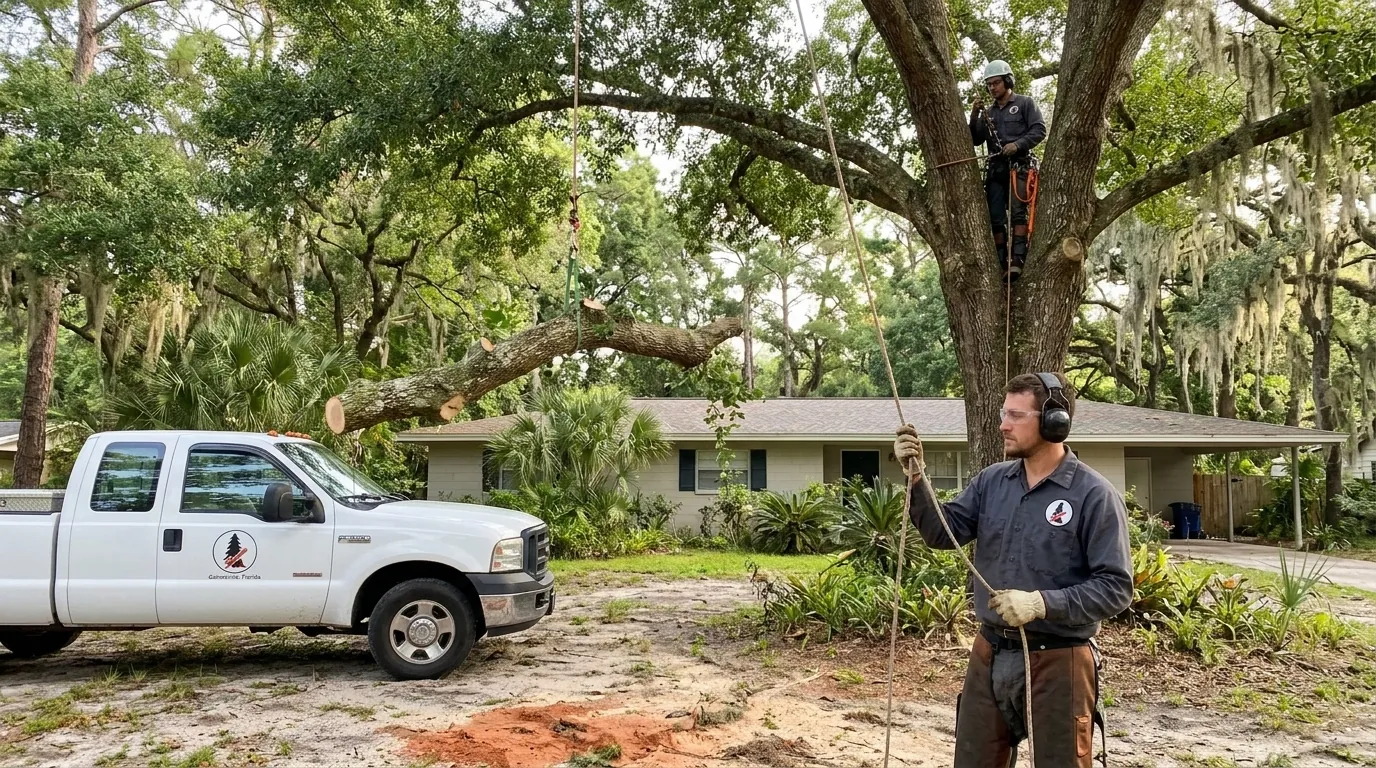
Canker on stressed oaks
One sign worth knowing is Hypoxylon canker, now often called Biscogniauxia canker. It shows up as patches of bark falling away to reveal a gray to black crust on the trunk or limbs. UF/IFAS describes the fungus as one that does not usually harm healthy trees but moves quickly in trees stressed by drought, root injury, soil compaction or construction damage. Once its fruiting structures are visible on the trunk, UF/IFAS says the tree is unlikely to survive. Oaks with this on the main trunk are usually removal candidates, and they become brittle fast.
Other warning signs include conks or mushrooms at the base, dead upper limbs while the lower crown stays green, and old pruning wounds that never closed. The article signs a tree needs to be removed covers them with photos.
Oak Tree Removal Permits: City Lots Versus County Lots
Oaks are where the permit rules get the most specific.
- Laurel and water oaks, City of Gainesville. On existing single-family lots, these two species stay outside the rules until the trunk is 30 inches thick at chest height, and past that only when they stand inside the zoning setback.
- Live oak and other high quality oaks, City of Gainesville. Live oak, sand live oak, bluff oak, basket oak and southern red oak all carry the city's High Quality designation. Past 20 inches, the rule follows them to every corner of the property.
- Unincorporated Alachua County. For home lots up to an acre, laurel and water oaks need a permit once they top 30 inches; other native oaks need one past 20. On larger lots, the county regulates trees over 8 inches.
Florida Statute 163.045 applies to oaks like any other tree: documentation that a tree poses an unacceptable risk at a single-family home removes the local permit requirement. We check the rules for your parcel before quoting. Older city neighborhoods like Florida Park and Kirkwood are full of big oaks inside city limits, while subdivisions like Haile Plantation fall under county rules and HOA review.
Large Oak Tree Removal in Gainesville: The Weight Problem
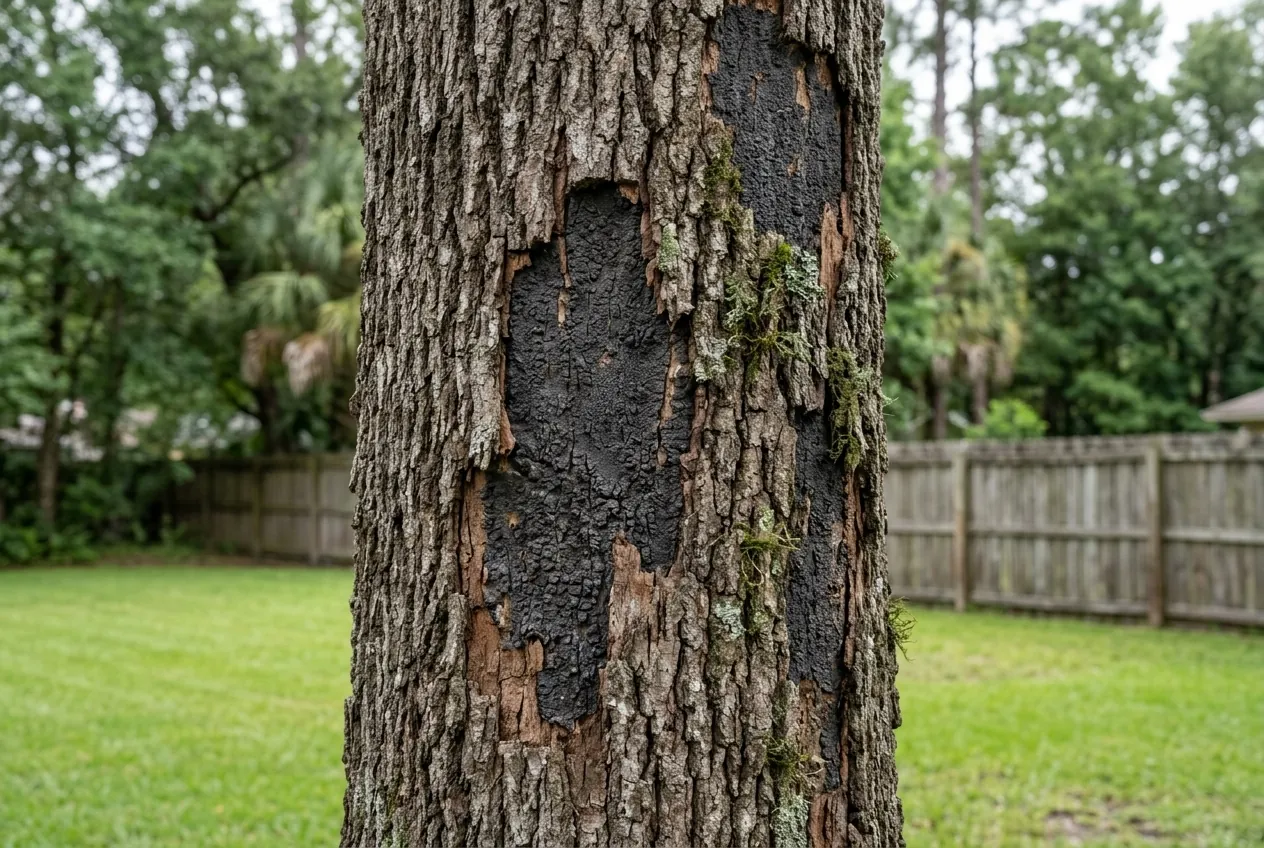
Oak is heavy wood, and green oak is heavier still because it is full of water. A short section of a large laurel oak leader can weigh several hundred pounds, and a trunk round from the base can be well beyond what two people can lift. That weight drives how an oak is taken down:
- Shorter pieces over roofs, so each one stays within what the rigging and the tree can handle.
- Lowering devices at the base, so the ground crew controls each drop instead of catching it.
- A crane when the pieces would be too heavy to lower safely, or the trunk is too decayed for rigging loads. Our crane tree removal page shows how those picks are rigged.
- Ground protection, because heavy oak rounds rolled across a lawn or dropped on pavers leave marks. Rounds are cut to sizes that can be carried or picked up by machine.
Protecting the oaks that stay
Many oak removals happen beside another oak the owner wants to keep. Live oak roots spread far past the edge of the crown and sit mostly in the top foot or so of soil, so a loaded truck parked on them, or a heavy trunk dropped on them, can do damage that shows up years later. We keep equipment off the root zones of trees that are staying, lay down mats where we have to cross them, and avoid piling logs against their trunks.
If you want to keep the wood, oak makes good firewood once seasoned, though it takes a long time to dry. We can cut rounds to length and stack them where you choose. Otherwise everything is hauled off.
Water oaks along the back fence
Plenty of oak removals involve trees nobody planted. Water oaks and laurel oaks seed in along fence lines and under power lines, grow fast for twenty or thirty years, then start pushing on fences and dropping limbs on sheds. Taking several of them at once, while the crew and chipper are already in the yard, is usually far cheaper per tree than calling for each one as it becomes a problem.
Oak Tree Removal Prices in Gainesville by Size
Most oak removals land in the medium or large ranges because of their size and weight. These ranges assume one tree with cleanup and hauling included.
| Job | Typical range | What moves the price |
|---|---|---|
| Young oak below 30 ft | $350–$850 | Room to drop it in one piece |
| Laurel or water oak between 30 and 60 ft | $850–$1,800 | Limbs over the roof and trunk condition |
| Big oak taller than 60 ft | $1,800–$3,500+ | Weight of the wood and distance to the street |
| Crane for heavy or decayed oak | +$600–$1,800 | Crane size and street setup |
| Firewood cut and stacked on site | Often lowers the price | Less wood to haul |
| Grinding the oak stump | $95–$450 | Width of the flare and surface roots |
Oak stumps tend to be wide with thick roots spreading near the surface, so they often sit at the higher end of the stump grinding range. If you are clearing several water oaks along a fence line, lot and land clearing pricing may work out better than individual removals.
Oak Tree Removal Gainesville Homeowners Can Plan
Send photos of the whole tree, the base and the leaves, along with what sits below the crown. We will identify the oak, check the permit rules for your parcel and give you one written price. If your oak sits close to the house, read removing a tree close to your house in Gainesville. For everything else about Gainesville tree removal, visit the homepage, or get a free estimate.
Oak Tree Removal Gainesville FAQ
Straight answers before you call.
On city home lots that already have a house, laurel and water oaks only come under the rules at 30 inches, and only inside the setback, while live oak and the other High Quality oaks fall under the rules from 20 inches no matter where they stand. In unincorporated Alachua County, small home parcels, an acre or under, trigger a permit for laurel and water oaks above 30 inches and for other native oaks above 20.
Live oak leaves are thick and leathery with edges that curl under, and the tree spreads wide with low, horizontal limbs. Laurel oak leaves are thinner, glossy and narrow, and the tree grows taller and more upright. Laurel oaks also drop many leaves in late winter, while live oaks stay green year-round.
Mushrooms or conks at the base usually mean decay in the roots or lower trunk, which is the part holding the tree up. It does not always mean the tree will fall soon, but it is a serious sign on a tree near a house, driveway or play area. Have it looked at.
Yes. We can cut it into rounds and stack it where you want. Fresh oak takes a long time to season, usually a year or more. Keep the pile away from the house to avoid inviting termites and other pests.
Usually not. Healthy live oaks are valuable, long-lived and protected by the city's High Quality list. If the problem is a heavy limb or a weak fork, pruning or support may solve it. We will tell you if removal is not the right answer, even though removal is the only service we provide.
Oaks spread wide over roofs with heavy limbs, so they need more rigging and more careful lowering. Pines are usually straighter and lighter, and come down faster. Oak wood is also heavier to carry and haul.
Quick estimate
Reply same dayTakes about 30 seconds.
We'll call you within one business day. If a tree is resting on your home or car right now, call (352) 301-4164 and we'll move you up.
Mon–Sat 7am–7pm
Why Homeowners Hire Us to Take Trees Down
- Fixed removal price on paper before the first cut
- Sections roped down over roofs, fences and screen rooms
- City and county tree rules checked for your parcel
- Storm damage photographed for insurance claims
- Logs, brush and chips hauled off the property
More Tree Removal Services in Gainesville
Other work we handle on the same visit.
All services- From $350
Tree Removal
Whole-tree takedowns, sectioned and lowered when space is tight.
- $400–$2,800
Dead Tree Removal
Dead and dying trees out before they come down on their own.
- $800–$3,500+
Hazardous Tree Removal
Leaning, split or rotten trees over homes and drives.
- 24/7
Emergency Tree Removal
Trees on roofs, cars and fences, any hour.
- +$600–$1,800
Crane Tree Removal
When there is nowhere safe to lower the wood.
- $350+
Pine Tree Removal
Beetle-killed, lightning-struck and leaning pines.
- $250–$1,200
Palm Tree Removal
Dead, diseased or unwanted palms removed to the root ball.
- $95–$450
Stump Grinding
Stumps ground below grade so you can sod over them.
Old Oak Over the House?
Tell us which oak. We'll tell you the rules and the price.