Alachua County town · 32694
Tree Removal in Waldo, FL
Waldo is a quiet railroad-era town with old houses, lakeshore lots and highways edged in tall pine. The trees that need to come out here are usually aging oaks over old roofs and tall pines that storms have killed or loosened, and we price each one in writing after seeing it.
- ZIP
- 32694
- Jurisdiction
- City of Waldo (or county outside city limits)
- Main roads
- US 301 and SR 24 (Waldo Road)
- Common removals
- Slash pine, laurel oak, water oak
Waldo Tree Removal in an Old Railroad Town
Waldo grew where the Florida Railroad crossed the old Bellamy Road. The depot there was named Waldo Station; surveyors laid out the town in 1859, and rails were extended south to Ocala in 1876. In 1877 a canal company got its charter to connect Lake Santa Fe and Lake Alto with the town by steamboat, bringing crops straight to the railroad. The city incorporated in 1907.
Waldo is small today. The 2020 Census counted 846 residents in about 2.2 square miles of land, fewer than in 2010. Removal work here falls into three buckets, and each needs its own plan: old houses on the original town grid, shoreline property near Lake Alto, and pine-covered lots on the two highways.
Waldo Oak Tree Removal Around the City Square
The houses on the original grid are some of the oldest in this part of Alachua County, and the oaks beside them were often planted generations ago. Laurel and water oaks in particular reach the end of their lives while still holding a full crown, then begin dropping heavy limbs or hollowing out at the base. A tree like that over a metal roof or an old porch is a removal, not a trim.
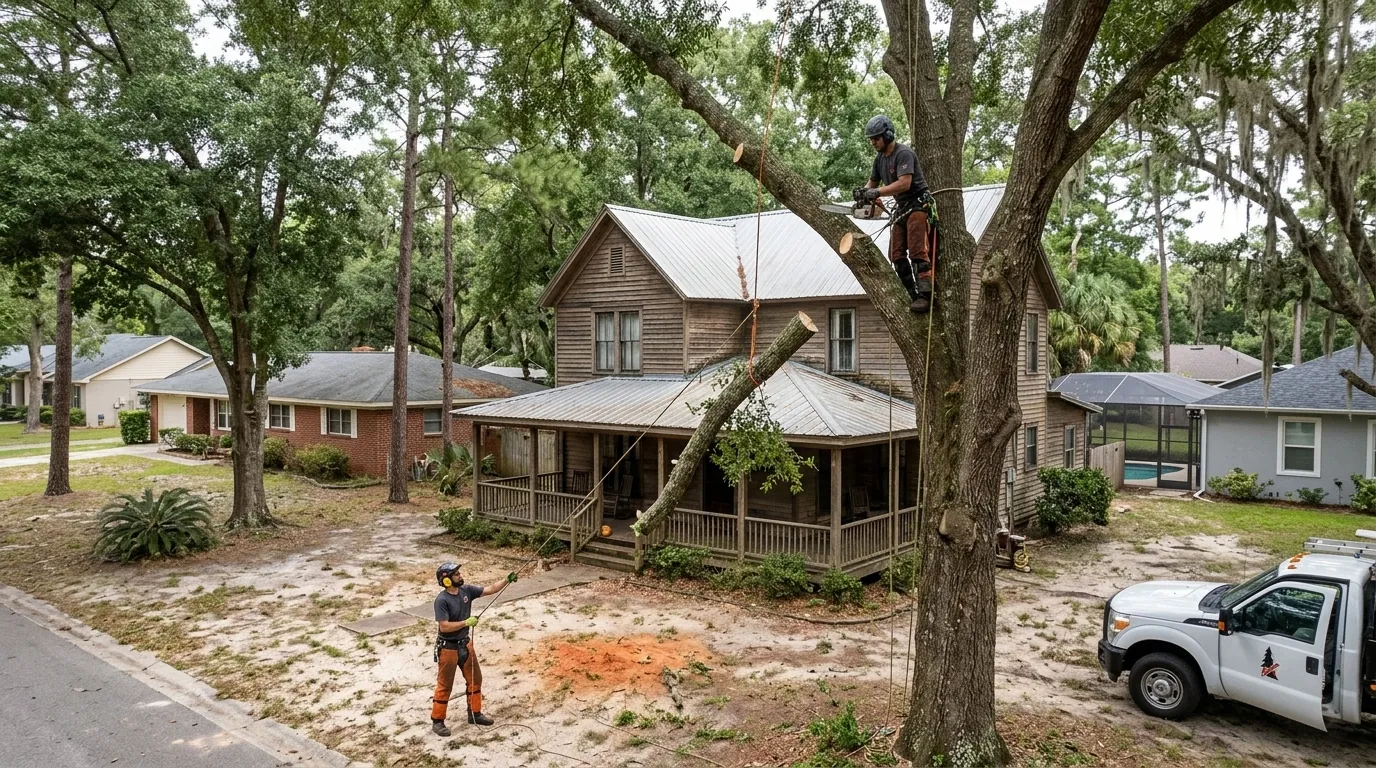
On these narrow lots there is rarely a clear place to drop a trunk. The tree is climbed, the crown is cut in manageable pieces and each piece is lowered by rope, keeping clear of roofs and overhead lines. Our oak tree removal page covers the method, and removing a tree close to your house explains how we protect older structures during the work. Not every big oak has to go. A sound live oak often only needs its longest limbs reduced, and if that's the smarter move we'll say so.
Waldo Pine Tree Removal on the US 301 Corridor
Both highways through Waldo run past stands of tall slash and longleaf pine, and many properties along them kept a few pines in the yard. In a hurricane those pines go first, and after a big blow the phone fills with calls about pines blocking driveways and highway frontage.
Needles that go rust-colored and then gray mean the pine is gone, most often to beetles, dry weather or a lightning strike, and the wood stiffens and cracks quickly. When it stands close to a building, pine tree removal means topping it and taking the stem down in sections. On open frontage it can often be felled whole, which costs less. Waiting rarely helps; dead tree removal gets harder as the wood dries, a point the post is a dead pine tree dangerous makes in detail.
Waldo Lakefront Tree Removal Near Lake Alto
East of town is Lake Alto, joined to Lake Santa Fe by the old canal that is now a paddling route. Lake Alto Estates offers lakefront and lake-access lots, some on acreage. Down at the water you see cypress and red maple, plus water oak and sweetgum; up the slope the mix turns to live oak and pine.
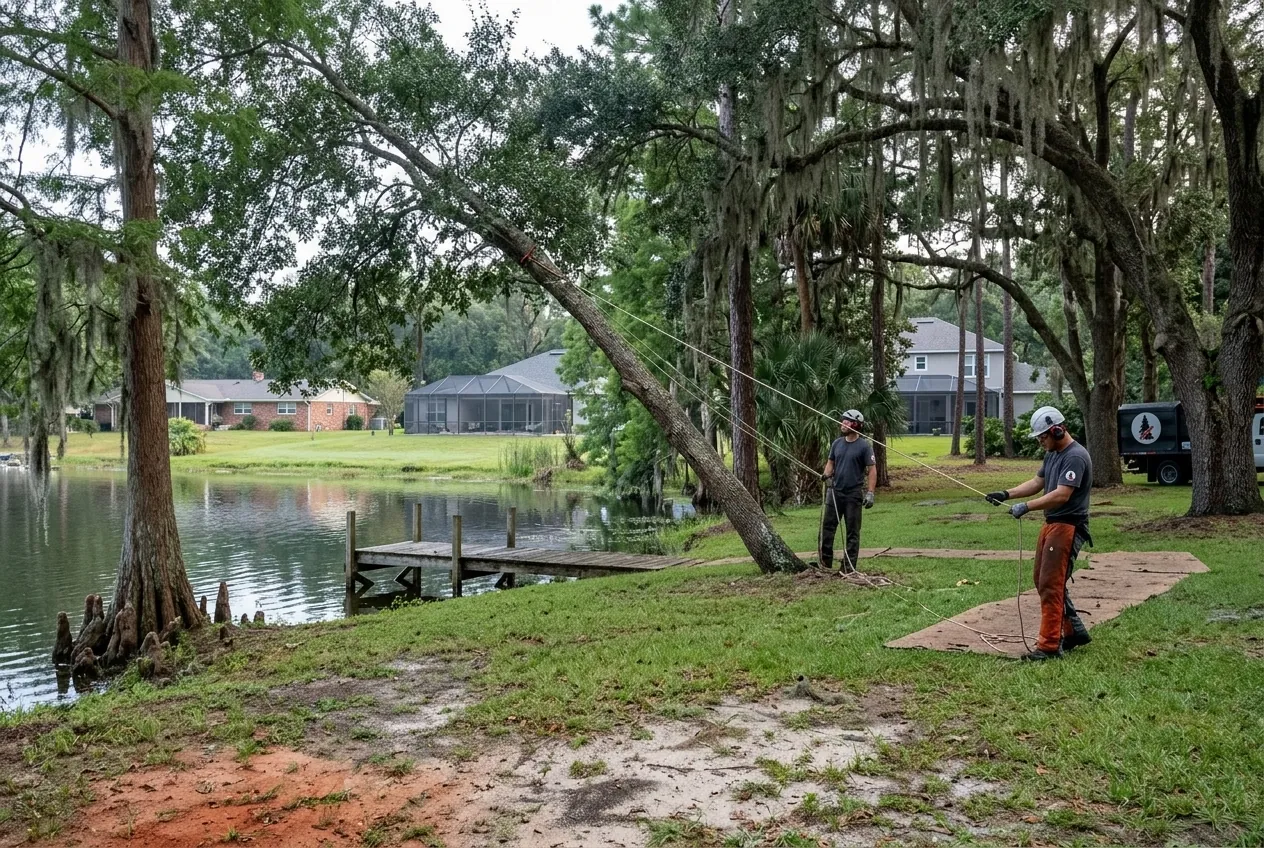
That lakeside soil stays soggy for weeks at a time. Roots never go deep, trees can roll out of the ground after a heavy rain, and a loaded truck can sink to its axles. On these lots we:
- pick a route across the firmest ground and lay mats on soft spots,
- carry or winch wood out instead of dragging it across the lawn,
- keep limbs, chips and sawdust out of the water,
- push heavy work like stump grinding to a dry stretch when the tree is not urgent.
Cypress rarely needs to come out. What usually needs to go is a water oak or sweetgum tipping toward the dock or the house, which falls under hazardous tree removal when the lean is getting worse.
Waldo Tree Removal Cost
Waldo jobs follow the same price ranges we use across the area, with the drive out SR 24 included in the written quote. Trees shorter than 30 feet usually cost $350 to $850 to remove. Trees from 30 up to 60 feet sit around $850 to $1,800. A tall oak or pine over a roof begins near $1,800 and can climb past $3,500. Most dead trees fall somewhere from $400 to $2,800, depending on height and what's below. Bringing in a crane to lift sections over a house tacks on $600 to $1,800, and a night or weekend storm call costs 25 to 50 percent more. Stump grinding costs $95 to $450 a stump, and acreage clearing at Clover Acres or similar rural parcels is priced per acre, starting around $1,800 for light growth. Lake lots can take longer because of carry distance. Bundling several trees on one trip is the simplest way to lower the cost per tree.
Waldo Tree Removal Permits and Power Lines
Waldo has its own land development regulations, and our habit is to call the city before taking down a large tree in town. Past the city line, the county takes over: on residential parcels no larger than one acre, a native tree measuring 20 inches across, or a laurel or water oak at 30 inches, needs an Alachua County permit. A failing tree on a residential lot is exempt from both under Florida Statute 163.045 if a qualified arborist or licensed landscape architect has put the hazard on paper.
Waldo handles its own water and sewer, but electricity is supplied by a private company that holds a franchise from the city. A limb on a wire is the power company's job first, so keep your distance until they've made it safe. For a tree on a house after hours, our emergency tree removal line covers Waldo around the clock. Wondering what the visit looks like? What happens on tree removal day walks through it.
Hazardous Tree Removal Before Storm Season in Waldo
Spring and early summer are the right time to deal with a risky tree here, before the afternoon storms and the hurricane season that follows. Walk your lot and look up. A pine with a dead or broken top, an oak limb over the roof that never leafed out, a long open crack in a trunk, or fungus growing from the base are all reasons to get a tree looked at. Along US 301, pay attention to anything that could fall toward the road, since a tree blocking a highway lane creates its own set of problems.
Trees that pose a clear danger are handled as hazardous tree removal, where the crew takes extra steps to control how the wood comes down. If roping sections down beside an older house isn't safe, a crane tree removal can lift them clear from the street. Either way, the estimate is free and the price is fixed before work starts.
Tree Removal Near Waldo
South on US 301, Hawthorne has the same pine-and-lake setting. SR 24 runs southwest into Gainesville past Ironwood, and farther in, Florida Park has older canopy over mid-century homes. For the whole city, see tree removal in Gainesville.
Local snapshot Waldo
- Residents
- 1,015 in 2010, 846 by the 2020 Census
- Land area
- 2.17 sq mi of land inside city limits
- Platted
- 1859
- Incorporated
- 1907
- Canal history
- An 1877 charter aimed to connect Waldo by water with Lake Alto and Lake Santa Fe
- City water system
- 57 years old in a 2022 report
- Distance to Gainesville
- About 14 miles northeast, straight line
Landmarks & streets Near our work
- Waldo city squareHeart of the old grid, where mature oaks hang over older roofs and service lines.
- Lake AltoEast of town, where cypress and red maple grow on soft shoreline ground that shapes how the crew stages a job.
- Waldo CanalThe 1800s steamboat route between Lake Alto and Lake Santa Fe, now a paddling trail lined with wetland trees.
- Waldo Farmers and Flea MarketThe well-known market on US 301, on land once used to grow flowers.
- US 301The main highway through town, lined with tall pines that can block lanes after a storm.
- SR 24 (Waldo Road)The direct road to northeast Gainesville and our route out to Waldo jobs.
Waldo Tree Removal FAQ
Straight answers before you call.
For big trees inside the city, we get confirmation from city staff. Outside the city line, Alachua County regulates large natives on home lots up to one acre. A dangerous tree with written documentation is usually exempt under state law.
It depends on the species and its condition. A sound live oak often just needs heavy limbs reduced. Laurel and water oaks with rot near the ground or big dead limbs are usually better off gone. We look at it and tell you plainly.
Yes. We plan access over firm ground, lay mats on soft spots, carry wood out rather than drag it, and keep debris out of the lake. Stump grinding can wait for dry weather if the tree isn't urgent.
Usually $400 to $2,800, depending on height, how brittle it is and what's beneath it. A pine we can fell into open ground costs less than one sectioned over a roof. Stump grinding adds $95 to $450.
Blocking the highway or touching wires? Phone 911 or the power company and stay clear. After that, reach us any time. If the house was hit, we take photos for the insurer before the saw comes out.
Neighborhoods & Towns Near Waldo
Close by, same crew.
All service areasQuick estimate
Reply same dayTakes about 30 seconds.
We'll call you within one business day. If a tree is resting on your home or car right now, call (352) 301-4164 and we'll move you up.
Mon–Sat 7am–7pm
Why Homeowners Hire Us to Take Trees Down
- Fixed removal price on paper before the first cut
- Sections roped down over roofs, fences and screen rooms
- City and county tree rules checked for your parcel
- Storm damage photographed for insurance claims
- Logs, brush and chips hauled off the property
Tree Removal Services Available in Waldo
Other work we handle on the same visit.
All services- From $350
Tree Removal
Whole-tree takedowns, sectioned and lowered when space is tight.
- $400–$2,800
Dead Tree Removal
Dead and dying trees out before they come down on their own.
- $800–$3,500+
Hazardous Tree Removal
Leaning, split or rotten trees over homes and drives.
- 24/7
Emergency Tree Removal
Trees on roofs, cars and fences, any hour.
- +$600–$1,800
Crane Tree Removal
When there is nowhere safe to lower the wood.
- $850+
Oak Tree Removal
Laurel and water oaks at the end of their life span.
- $350+
Pine Tree Removal
Beetle-killed, lightning-struck and leaning pines.
- $250–$1,200
Palm Tree Removal
Dead, diseased or unwanted palms removed to the root ball.
Get a Fixed Price for Your Waldo Tree
Need a tree out in Waldo? We’ll price it free.