
Gainesville neighborhood · 32653
Tree Removal in Mile Run, Gainesville, FL
Mile Run went up in phases between the mid-1980s and late 1990s, and the oaks planted with those homes have reached the age where many start to fail. Between attached units and tight side yards, removals here are planned around shared walls, phase associations and city tree rules.
- ZIP
- 32653
- Jurisdiction
- City of Gainesville
- Electric
- GRU (confirm on your bill)
- Common removals
- Laurel oak, water oak, sweetgum, loblolly pine
Mile Run Tree Removal for 35-Year-Old Oaks
You'll find Mile Run in northwest Gainesville, tucked into the corner where NW 43rd Street meets NW 53rd Avenue, on the north and east sides of that intersection. Listing records show homes going up from 1984 through 1999 in a string of phases, from Mile Run East Phase II to Phase V and beyond, on streets such as NW 37th Terrace and NW 54th Lane. The housing is a mix of detached homes, attached homes and townhouses, with shared amenities like a pool, courts and walking paths.
The trees tell the same timeline. Most of the shade here was planted alongside the houses, which makes the oldest laurel oaks, water oaks and sweetgums somewhere around 35 to 40 years old. Laurel oaks in that age bracket often begin decaying where old pruning wounds or root damage let fungus in, and a lot of them were set close to the houses when they were saplings. The result is a neighborhood full of big trees in small spaces, many of which now need to come down.
Mile Run Tree Removal, Step by Step
Removals here involve more people than the homeowner and the crew, so the order of steps matters. A typical job runs like this:
- Check who owns the tree. In attached and townhouse sections, a tree may sit on common ground owned by your phase's association rather than on your lot. Your plat or the association can confirm.
- Check what your phase covers. Mile Run is split among several associations with different dues. At least one covers exterior maintenance including roofs, while others handle only common areas. Some require approval before any tree comes out.
- Check the city rule. The neighborhood falls under Gainesville's Heritage Tree code, covered below.
- Get a written price. We quote you or the association, whichever is paying, with the method and cleanup spelled out.
- Schedule around the neighbors. On shared driveways and attached units, we let you know how long the drive will be blocked so adjoining owners can move cars.
Still deciding whether a tree is actually failing? A short read on when a tree needs to be removed covers the red flags, and what happens on tree removal day explains the visit itself.
Mile Run Oak Tree Removal Between Attached Homes
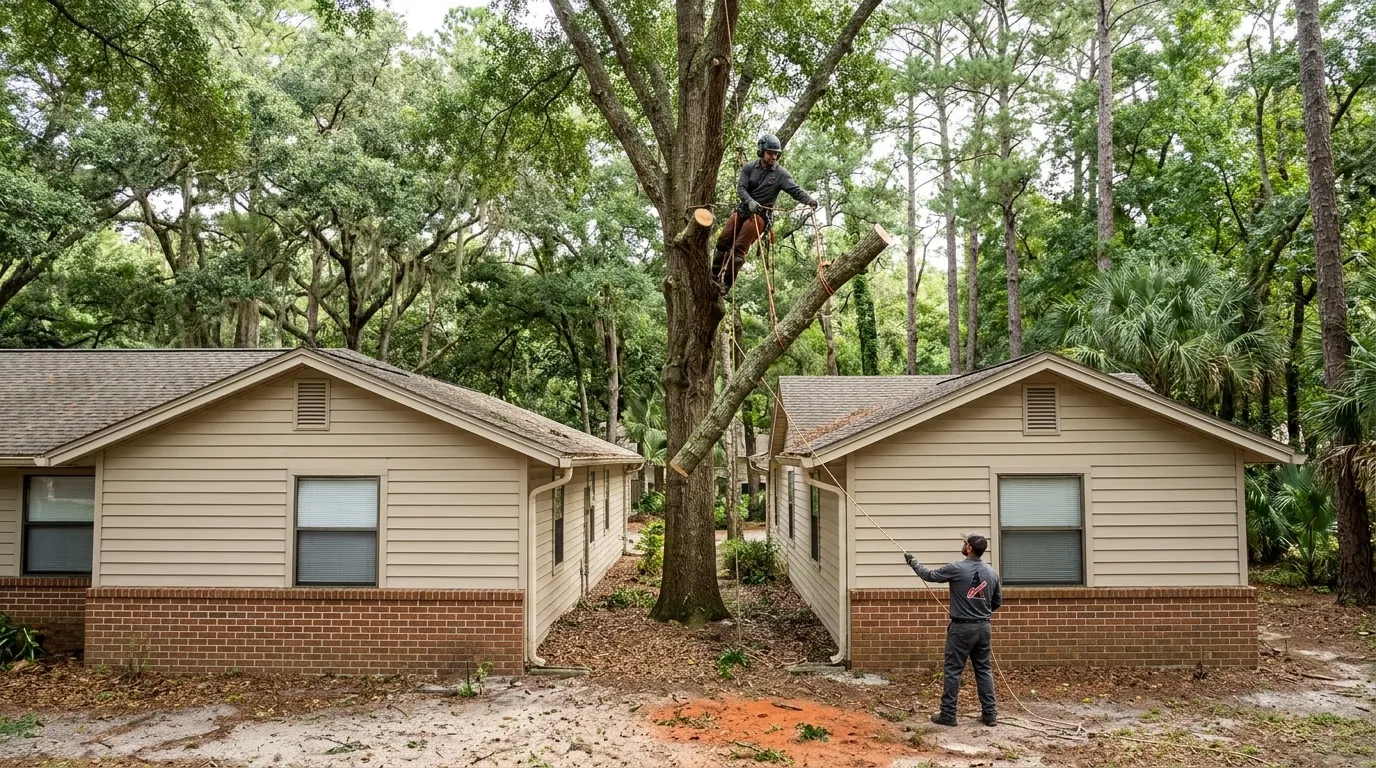
The hardest Mile Run jobs are oaks growing in the gap between two units or between a unit and a privacy fence. There is no landing zone and often a shared roofline on both sides. In that setup, a climber takes the crown apart from the top down, lowering each piece on a rigging line through a pulley set higher in the tree. The groundworker steers the load clear of gutters, AC units and patio screens. Once the crown is gone, the trunk comes down in short sections. Our oak tree removal page goes through why laurel and water oaks fail and how we take them apart.
Sweetgums and loblolly pines are the other regulars. Sweetgums drop heavy limbs as they age and push roots into slabs and walkways. Pines planted or saved during construction can die quickly after drought or beetle attack, and the dead pine tree guide explains why waiting makes them harder and pricier to remove. For any tree already dead on its feet, see dead tree removal.
Mile Run Tree Permits and Landscape Plan Trees
For a stand-alone house, the city's code reaches only Heritage Trees. The trunk is measured at chest height, 4.5 feet off the ground; 20 inches makes most species Heritage size, but the fast-growing group of laurel and water oaks, sweetgums and the two common yard pines doesn't qualify until 30. Prized species on the city's High Quality list, live oak and magnolia among them, are protected wherever they grow on the lot. Applying costs nothing.
Mile Run adds a wrinkle. Gainesville's guidance says trees that were part of a planned development's approved landscaping, think street plantings or trees in a parking lot island, may be protected no matter their size. Trees along common drives in the attached sections may fall into that group. When a tree looks like part of the original planting scheme, we check with the city before quoting the removal. Separately, Florida Statute 163.045 lets a dangerous tree on a residential lot be removed with no city permit, provided the hazard is documented by a certified arborist or a landscape architect with a Florida license.
Mile Run Hazardous Tree Removal Along Possum Creek
Possum Creek Park sits on Mile Run's south side, 76 acres of trails through forest and floodplain at 4009 NW 53rd Avenue. The creek drains roughly 8 square miles and is the largest tributary of Hogtown Creek. Yards that back toward it sit on damper ground, and trees there root shallow. In a summer squall or a hurricane like Idalia in 2023, those are the trees most likely to tip whole or drop limbs across back fences.
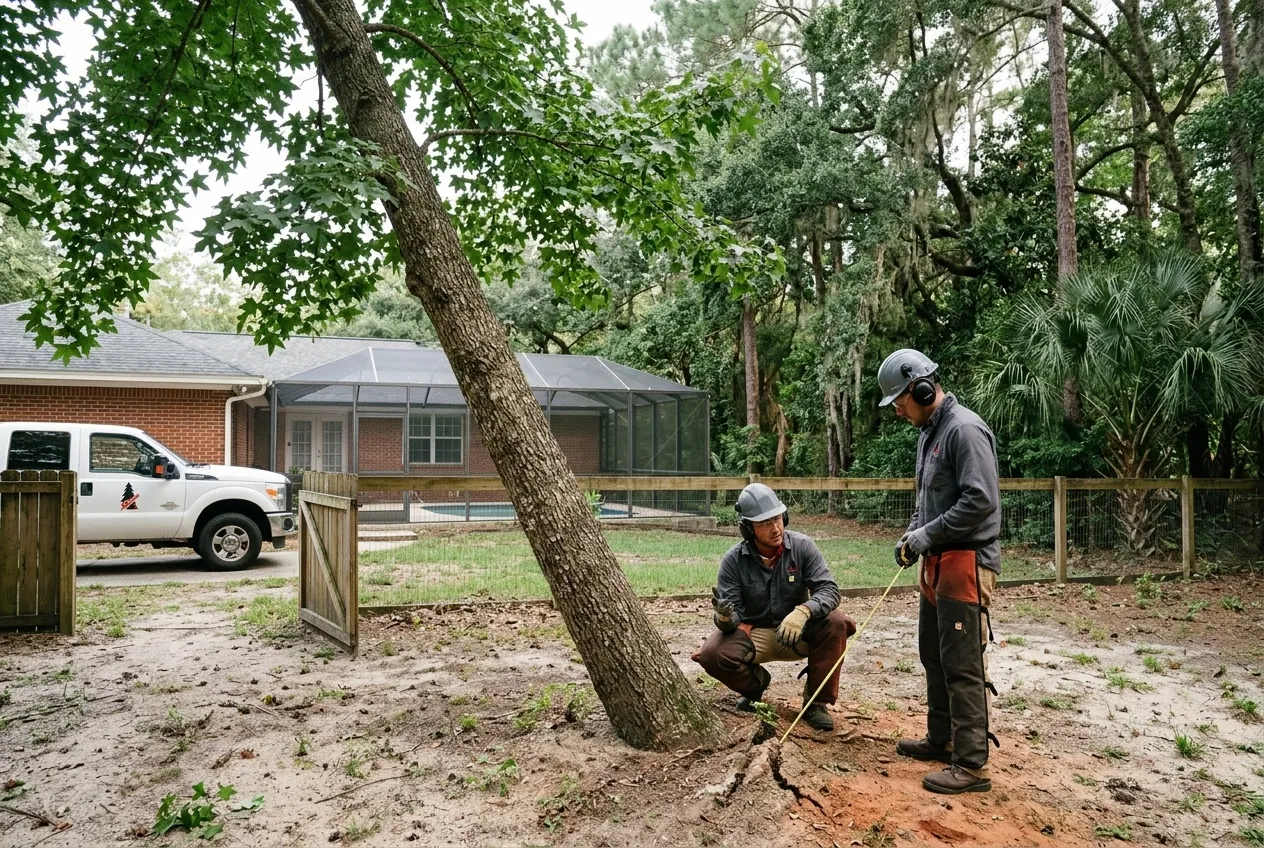
For a tree leaning over a roof or split at the trunk, hazardous tree removal gets it down before the next storm does it for you. For a tree already on a house or car, the emergency tree removal line answers 24/7. If a fallen tree crosses into the park or a neighbor's lot, our guide to neighbor tree damage and who pays sorts out the usual question of responsibility.
Mile Run Tree Removal Cost
Height matters less in Mile Run than access. Picture a 40-foot laurel oak squeezed into the gap between two units. Every limb has to be roped down, so it can easily outprice a 70-foot pine standing alone in a backyard. Typical ranges from our standard price sheet:
- Small tree under 30 feet: $350 to $850.
- Mid-size trees in the 30 to 60 foot class: $850 to $1,800.
- Big oaks or pines hanging over a roof: from $1,800, and $3,500 or more for the hardest rigging.
- Crane assist when nothing can be lowered by rope: add $600 to $1,800.
- Stump grinding near slabs and walks: $95 to $450 per stump.
Associations that want several trees handled at once often get a lower cost per tree, since setup is shared. Every price is fixed in writing before the saw starts.
Tree Removal Near Mile Run
West along NW 53rd Avenue, Millhopper mixes tall pines on acreage with sinkhole country. Closer to UF, Florida Park deals with heavy oak canopy over mid-century homes on sloping lots. Up US 441 to the northwest, High Springs trades tight lots for river acreage. For everything else in the city, see tree removal in Gainesville, FL.
Local snapshot Mile Run
- Build years in listing records
- 1984 to 1999
- Median year built, census tract 18.03
- 1983 (ACS 2020–2024 5-year)
- ZIP 32653 population
- 15,150 (ACS 2020–2024 5-year)
- Owner-occupied homes, ZIP 32653
- About 83% (5,425 of 6,505; ACS 2020–2024)
- Possum Creek Park
- 76 acres at 4009 NW 53rd Ave
- Possum Creek watershed
- About 8 sq mi; largest tributary of Hogtown Creek
- Distance to City Hall
- About 4.8 miles, straight line
Landmarks & streets Near our work
- Possum Creek ParkThe 76-acre city park on NW 53rd Ave, with forest and floodplain trails; hammock trees along its edge overhang back fences.
- Possum CreekFlows about 6.5 miles south to Hogtown Creek; low ground near it stays damp and roots stay shallow.
- NW 53rd AvenueThe road along Mile Run's south side and the main way trucks and chippers come in.
- NW 43rd StreetThe west-side corridor; most crews approach from here and turn east onto NW 53rd Ave.
- William S. Talbot ElementaryOn NW 43rd St; drop-off and pickup traffic shapes when we park equipment.
- Hunters Crossing shopping centerAbout a mile away at a busy intersection, where we plan around peak traffic for large loads.
Mile Run Tree Removal FAQ
Straight answers before you call.
It depends on your phase and where the tree stands. Trees on common ground in attached sections usually belong to the association. Check your plat or ask the board. We can write the quote to either party.
Some Mile Run phases require it and some don't. Read your phase's documents or ask the board before scheduling. If the board wants paperwork, we can write up the tree's condition for their file.
Only for regulated trees. On a detached single-family lot that means Heritage Trees, which for laurel and water oaks starts at 30 inches in diameter. Original street and common-area plantings may be protected at any size, so we confirm those with the city.
Most were planted with the houses between the mid-1980s and late 1990s. Laurel oaks are relatively short-lived and commonly develop internal decay around 35 to 50 years old, often without obvious signs in the crown.
A climber dismantles it from the top, roping each cut down so neither roof takes a hit. If there is no way to lower wood safely, a crane can lift sections out to NW 53rd Avenue or the nearest street.
Mid-size oaks usually land between $850 and $1,800. Big ones leaning over a house begin near $1,800, and the hardest rigging jobs run past $3,500. Tight access between units is the biggest factor. Stump grinding adds $95 to $450 per stump.
Neighborhoods & Towns Near Mile Run
Close by, same crew.
All service areasQuick estimate
Reply same dayTakes about 30 seconds.
We'll call you within one business day. If a tree is resting on your home or car right now, call (352) 301-4164 and we'll move you up.
Mon–Sat 7am–7pm
Why Homeowners Hire Us to Take Trees Down
- Fixed removal price on paper before the first cut
- Sections roped down over roofs, fences and screen rooms
- City and county tree rules checked for your parcel
- Storm damage photographed for insurance claims
- Logs, brush and chips hauled off the property
Tree Removal Services Available in Mile Run
Other work we handle on the same visit.
All services- From $350
Tree Removal
Whole-tree takedowns, sectioned and lowered when space is tight.
- $400–$2,800
Dead Tree Removal
Dead and dying trees out before they come down on their own.
- $800–$3,500+
Hazardous Tree Removal
Leaning, split or rotten trees over homes and drives.
- 24/7
Emergency Tree Removal
Trees on roofs, cars and fences, any hour.
- +$600–$1,800
Crane Tree Removal
When there is nowhere safe to lower the wood.
- $850+
Oak Tree Removal
Laurel and water oaks at the end of their life span.
- $350+
Pine Tree Removal
Beetle-killed, lightning-struck and leaning pines.
- $250–$1,200
Palm Tree Removal
Dead, diseased or unwanted palms removed to the root ball.
Get a Written Price for Your Mile Run Tree
Need a tree out in Mile Run? We’ll price it free.