 A tree just hit the house?
 Don't see your street?
People use the two terms as if they mean the same thing, and many quotes don't say which one is included. They're very different jobs. Here's what each one involves, what it costs around Gainesville, FL, and the local factors that should push you one way or the other.
Stump Grinding Explained
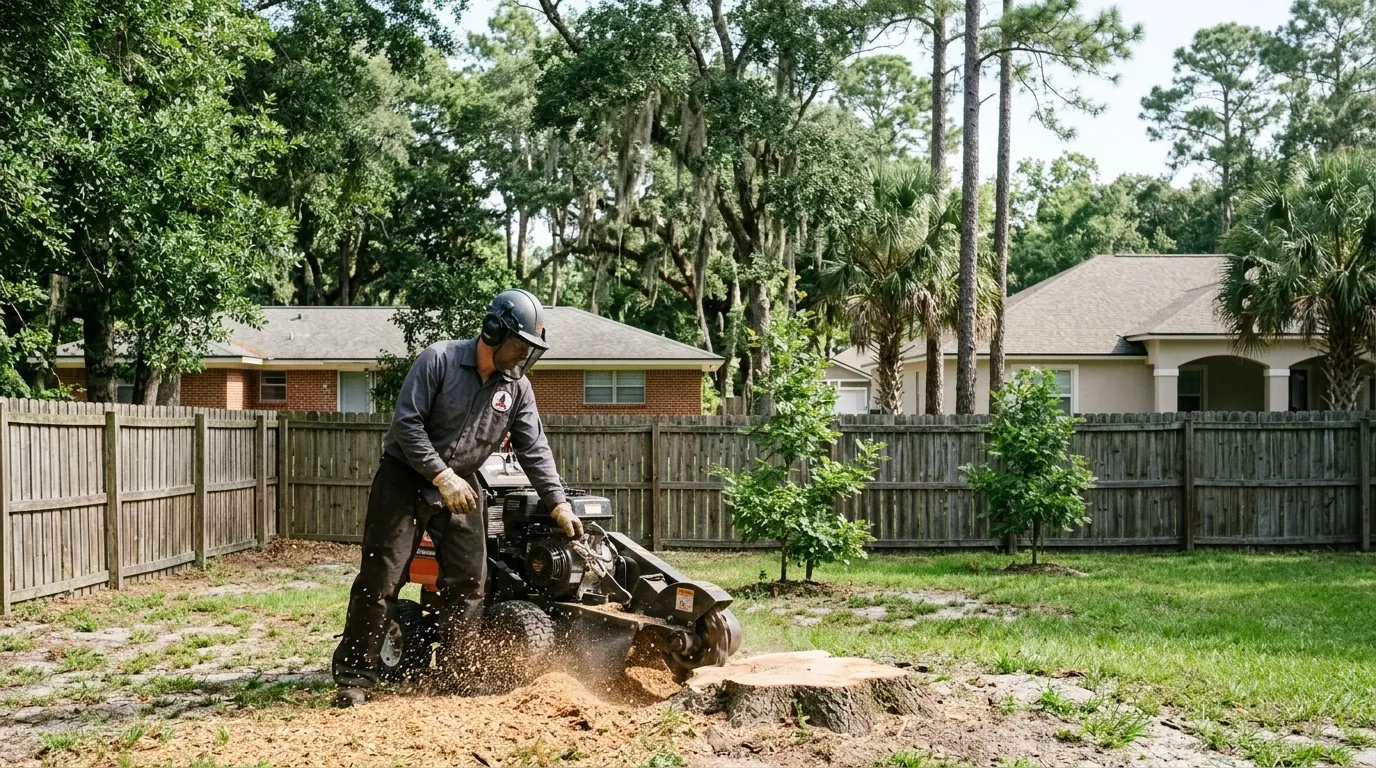
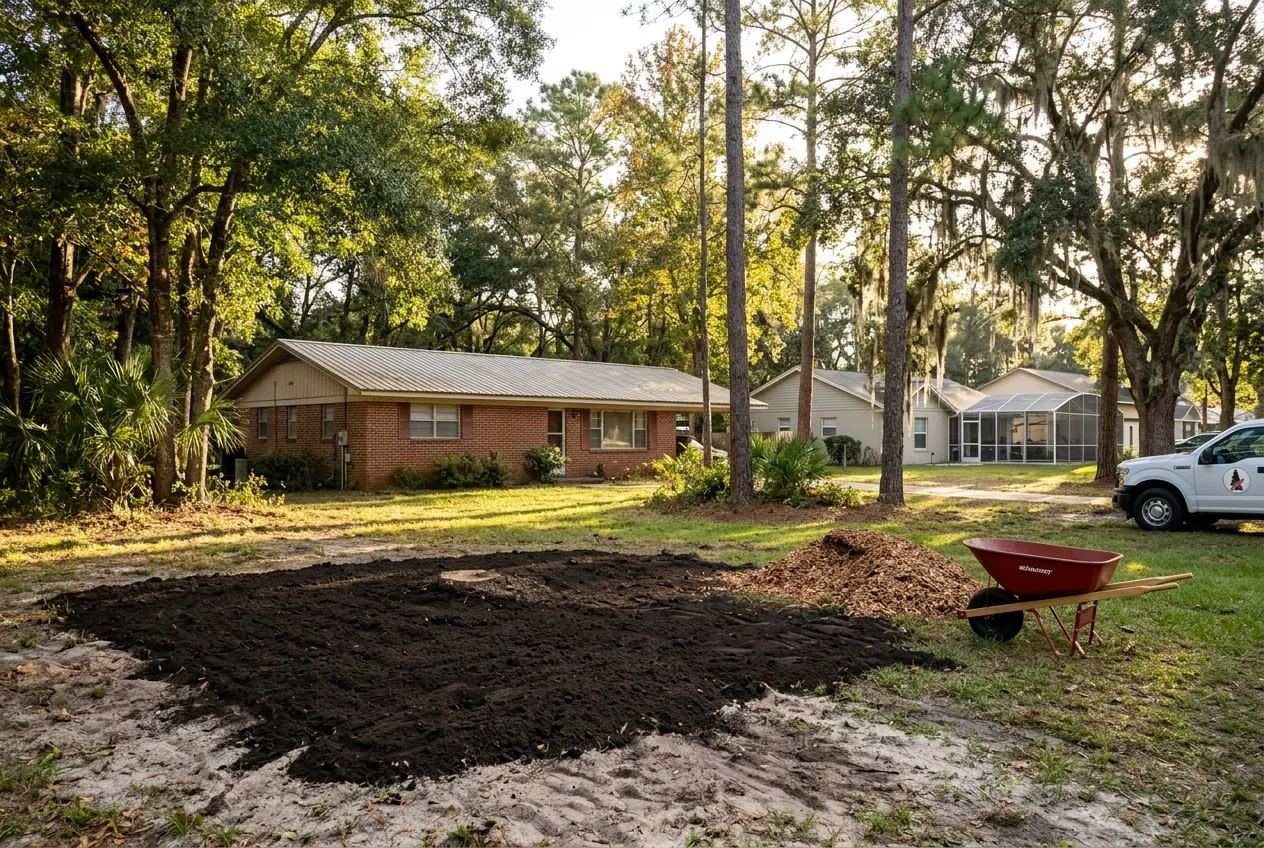
The machine does its work with a heavy cutting wheel studded with carbide teeth. The operator sweeps it side to side across the stump, shaving the wood into chips a little at a time, then lowers it and makes another pass. The stump and the top of the major roots are turned into a mound of chips and soil.
- The stump ends up several inches below the surrounding soil, deep enough for sod or mulch.
- Surface roots near the stump can be chased and ground a few feet out, usually for an added charge.
- Deeper roots stay in the ground and decay slowly over years.
- Compact grinders fit through many backyard gates, so access is rarely a deal-breaker.
Our stump grinding is usually priced between $95 and $450 a stump. Width, the number of surface roots to chase and how hard the stump is to reach set the figure.
Stump Removal Explained
Full stump removal, sometimes called stump extraction, digs the stump and its main root mass out of the ground with an excavator or similar machine. What's left is a large hole, often several feet across, that has to be backfilled with clean soil and compacted.
- The root ball and most of the main roots leave the site.
- The ground is disturbed well beyond the stump's footprint.
- Lawn, irrigation and nearby plants in the dig area usually need repair afterward.
- It needs room for heavy equipment and a place to set the root ball and the fill.
Because extraction depends so much on the machine, the root spread and how much fill is needed, it's priced on site. It nearly always costs more than grinding the same stump.
Stump Grinding vs. Stump Removal Side by Side
| Question | Stump grinding | Full stump removal |
|---|---|---|
| What's left behind | Chips and soil, roots below grade | A hole to backfill, most roots gone |
| Yard disturbance | Small, mostly the stump footprint | Large, several feet around the stump |
| Equipment | Grinder, often gate-width | Excavator or heavy loader |
| Typical cost | $95 to $450 per stump | Priced on site, usually well above grinding |
| Good for | Lawns, beds, most yards | New slabs, pools, footings, driveways |
| Time | Under an hour for most stumps | Half a day or more with backfill |
When Stump Grinding Is the Right Choice
For most Gainesville yards, grinding is enough. Choose it if you plan to:
- Cover the spot with new sod or grass seed
- Turn the area into a mulched bed
- Simply get rid of a tripping hazard or mowing obstacle
- Replant nearby, offset from the old trunk by a few feet
Grinding also leaves the soil structure around the stump mostly intact, which matters near fences, walkways and the house. If the stump is close to a foundation, grinding is almost always preferred over digging.
When Full Stump Removal Makes Sense
Extraction earns its cost when the ground where the tree stood has to carry a load or be dug deeply:
- A slab, addition or shed is going over the spot
- A pool, driveway or footing will be excavated there
- A new tree must go in the exact same hole
- The site is being prepared for building, and the builder requires roots out
On larger land jobs, root balls are often pulled as part of lot and land clearing so the ground can be graded. Communities that are still growing, such as the newer phases around Tioga, see more of this kind of work than established neighborhoods.
Gainesville Stump Grinding Factors: Sandy Soil and Settling
Much of Alachua County sits on sandy soil over limestone. When a large stump and its roots decay underground, the space they filled slowly collapses, and the surface can settle into a shallow dip over the following years. That's normal, and it's easy to fix by topping the spot with soil as it sinks. Rake out most of the grindings rather than burying them under sod, since chips break down and shrink faster than soil.
In towns with porous limestone near the surface, like High Springs close to the Santa Fe River, a dip that keeps growing well beyond the old stump is worth a second look, since it may have nothing to do with the tree. If you're unsure, ask during the estimate.
Stump Grinding or Leaving the Stump Alone
Grinding isn't required. Some owners keep a stump on purpose: as a base for a planter, a seat at the edge of a wooded lot, or simply because it sits in a corner nobody mows. A stump left in place will decay on its own over many years, faster in our warm, wet summers than in colder climates, but still slowly for a big oak.
Leaving it makes sense when the stump is far from the house, isn't in a mowing path and belongs to a species that won't resprout. It's a poorer choice when the stump is near the foundation, sits where kids play, or is a camphor or tallow that will keep sending up shoots. If you're on the fence, you can always add grinding later. A return trip costs a bit more than doing it with the removal, but the option doesn't go away.
- Keep it if it's out of the way, sound, and a non-sprouting native.
- Grind it if it's in the lawn, near the house or a trip hazard.
- Extract it if something will be built or dug where it stands.
Termites and Leftover Stumps
Decaying wood in the soil is food for subterranean termites. UF/IFAS Extension's termite prevention guidance tells homeowners to remove wooden debris such as lumber and branches from the property and to eliminate contact between wood and soil near the house. A stump right beside the foundation is exactly the kind of wood-to-ground contact that guidance warns about.
Grinding removes the bulk of that wood. If you already see termite activity in a stump near the house, talk to a licensed pest control company before you disturb it, since breaking up an active colony can move the termites elsewhere.
Stump Grinding and Trees That Resprout
Some trees don't stay dead when cut. Camphor tree is a Category I invasive in Florida, and UF/IFAS notes that some invasive species can regrow from any part of the stump or lateral roots that survive grinding. Chinese tallow is another strong resprouter. For these species, grinding works best paired with a cut-stump herbicide treatment applied right after cutting, plus follow-up on any sprouts. Most native oaks and pines don't need that step.
Palms are a separate case. They don't have a woody taproot, just a dense mass of fibrous roots. When we do palm tree removal, the stump is ground or the root ball is dug out, and either option leaves a cleaner spot than a hardwood stump does.
Underground Lines and Stump Grinding
Grinders reach well below the surface, and stumps often sit right next to irrigation, cable or utility lines. Florida's Sunshine 811 asks anyone digging to contact it at least two full business days ahead. We get locates before grinding where buried lines could be present, and we ask you to flag private sprinkler and lighting lines that 811 won't mark.
What to Do With Stump Grindings
- Rake and backfill. Pull most chips out of the hole, fill with topsoil, then sod or seed.
- Use them as mulch. Spread a thin layer around shrubs, not piled against trunks or the house.
- Have them hauled. Removal of grindings can be added to the quote.
- Keep chips away from the foundation, for the same termite reasons as the stump.
Grinding is usually the last step of a takedown. To see where it fits in the day, read what happens on tree removal day. For stumps right beside a wall, see removing a tree close to your house. Or snap a picture of the stump and ask for a free estimate.